Casino
 Betting
 Games
Games 
 Banking
 Bonuses

Can Esports Replace RMG in India After the Ban?

- Can Esports Replace RMG in India After the Ban?

 Author: Lukas Mollberg
 Updated: 29 June, 2026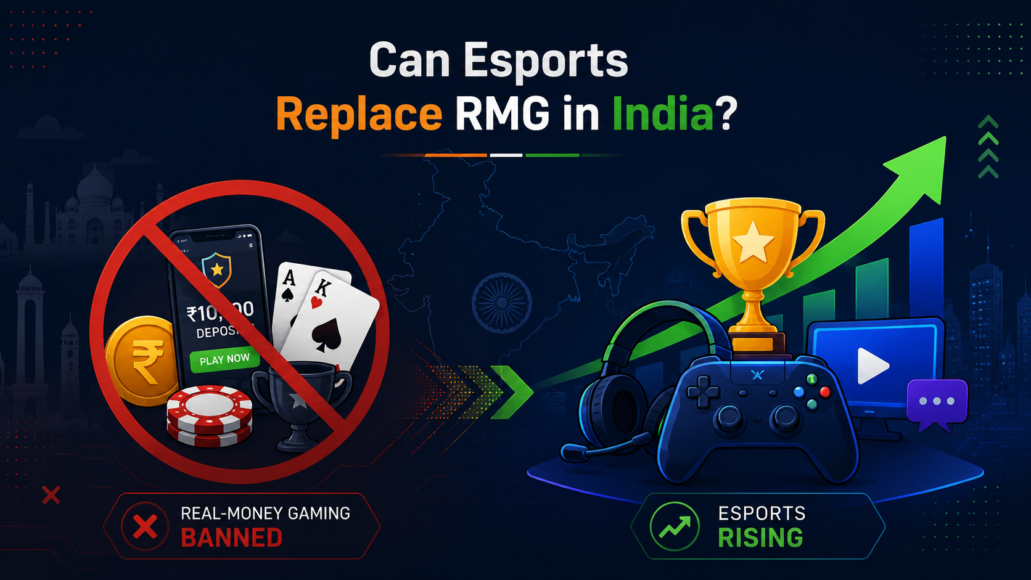
India made two decisions at once in 2025, and they pull in opposite directions. With the Promotion and Regulation of Online Gaming Act, the government banned real money gaming across the board, then turned around and gave esports the formal recognition the sector had wanted for years. The Act passed in August 2025 and took full effect on 1 May 2026 alongside its accompanying rules.
The ban does not separate skill from chance, so fantasy sports, rummy, poker and similar formats all fall under the same prohibition. For an industry that built its scale on paid entry and cash prizes, this was a hard stop. Yet the same law treats competitive gaming as a legitimate sport with a path to government support. The question we keep coming back to is simple. Can one model genuinely stand in for the other, or are we comparing two very different businesses that happen to share a screen?
What the ban actually took apart
Real money gaming was not a side niche in India. It carried the largest share of the country's online gaming revenue, with some estimates putting it above 80 percent of the value pool before the ban. The format worked because millions of users paid small entry fees, and the sheer volume made the economics add up. When the law cut off advertising, payment flows and the games themselves, the revenue engine stopped almost overnight. Major operators such as Dream11, MPL, WinZO, Zupee and Games24x7 either closed their cash offerings or moved to free to play versions.
The Online Gaming Authority of India, set up under the Ministry of Electronics and Information Technology, now classifies games and maintains the list of banned titles. What disappeared was not just a set of apps. It was a proven way to turn a large, price sensitive user base into steady income, and nothing in the esports model replaces that mechanism directly.
The funding engine that vanished
The part that rarely gets enough attention is capital. RMG was the magnet that pulled serious money into Indian gaming, and the ban forced investors to write down years of bets. The scale of the unwind is worth listing plainly:
- Roughly 400 RMG startups held around $15 billion in combined investment value, backed by more than $2 billion raised from venture capital.
- Within 90 days of the ban, platforms recorded asset write downs of more than $840 million, and about 7,000 workers lost their jobs.
- Flutter Entertainment booked a $556 million impairment after shutting its Junglee Games subsidiary.
- Nazara Technologies recorded a $103.2 million impairment on its stake in the parent of PokerBaazi, while Clairvest wrote off its investment in the operator of A23 Rummy.
Funds that once treated RMG as a reliable growth story are now cautious. Some are shifting toward esports, gaming infrastructure and overseas markets, but hesitation at the cheque stage is the bigger story for founders.
Why Delhi is backing esports
The government's preference is not hidden. Esports avoids the two things lawmakers objected to most, which were monetary stakes for players and the gambling association that came with them. Competitive gaming earns money through sponsorship, media rights, streaming, events and merchandise rather than player deposits, so it sits outside the logic the ban targeted. Recognition under the National Sports Governance Act gave the sector a legal standing it never had while it was bundled with RMG. The signals have followed.
Esports featured as a demonstration event at the Khelo India Youth Games in 2025, building on India's debut in the discipline at the 2022 Asian Games. Niko Partners has reported that around 60 percent of Indian gamers already engage with esports in some form, whether playing, watching or competing. For a government that wants a clean, family friendly growth sector, the appeal is obvious. The harder part is turning recognition into revenue at the scale RMG once delivered.
Where esports earns, and where it falls short
Esports has real strengths, but pretending it maps neatly onto the old model would be a mistake. The honest version sits somewhere in the middle. Some factors work clearly in its favour, while others show why it cannot simply absorb what RMG left behind. The table below sums up both sides:
| Esports strengths | Esports gaps |
| Clear legal standing, no gambling link | Revenue per user far lower than RMG |
| Earns through sponsorship, streaming and events | Capital still stuck at the seed stage |
| Backed by publishers like Krafton | Talent often leaves for film and TV |
| Around 60 percent of gamers already engaged | Viewership concentrated in a few titles |
So esports can grow the industry. What it cannot do quickly is reproduce the dense, high frequency cash flow that funded the last wave of startups.
What this means for the road ahead
For players in India, the practical reality is straightforward. Paid real money formats are off the table under current law, and the safer, legal path forward runs through esports, social games and skill based titles without cash stakes. We would also flag the risk regulators themselves have acknowledged, which is that blunt bans can push some users toward offshore sites that sit outside Indian oversight and offer no protection.
On the business side, the picture is still forming. Litigation challenging the law was pending before the Supreme Court into early 2026, so the legal ground may yet shift. Our read is that India has chosen to build a cleaner gaming sector and accept slower monetisation as the cost. Esports is the headline beneficiary, but it is the start of a new model rather than a like for like replacement for the old one.
The build phase will take years, not quarters. If you want the full breakdown, listen to our podcast episode, “Ban and Build: Can Esports Replace RMG? India backs esports while killing the model that funded its gaming startups“ where we walk through what the shift means for players and the wider market.

Lukas Mollberg
Casino Expert | Head of Content at CasinobleLukas Mollberg is an experienced iGaming analyst and editorial lead with more than twenty years in gaming and digital media, including over eight years focused on online casinos. As Head of Content at Casinoble, he guides the editorial team, shapes review methodology, and ensures that research and analysis are grounded in verified data and clear evaluation standards.
Most Read News
Get the latest information