Casino
 Betting
 Games
Games 
 Banking
 Bonuses

India’s War on Illegal Gambling: How the PROG Act and OGAI Are Cleaning Up a ₹20,000 Crore Crisis

- India’s War on Illegal Gambling: How the PROG Act and OGAI Are Cleaning Up a ₹20,000 Crore Crisis

 Author: Lukas Mollberg
 Updated: 19 June, 2026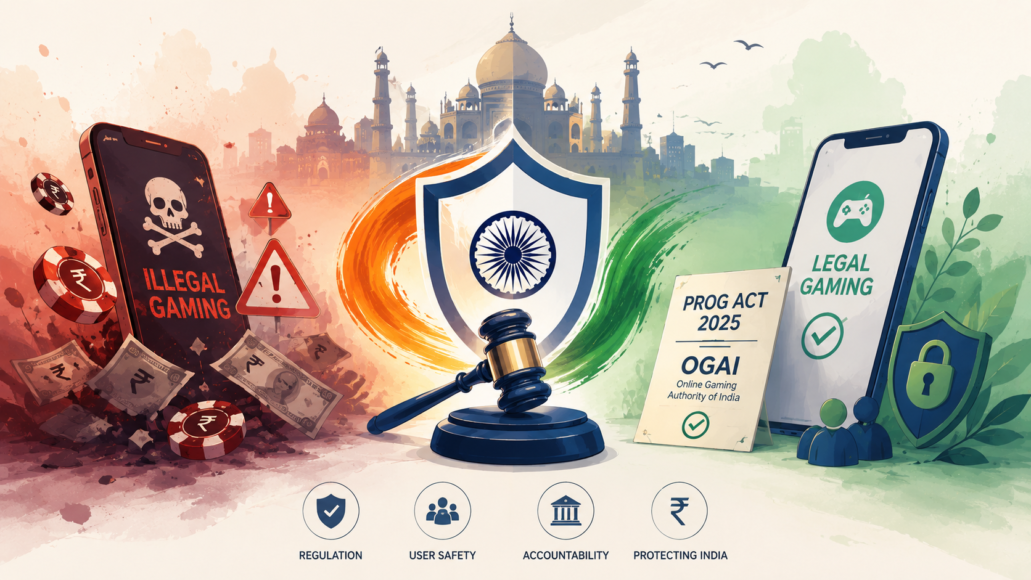
India has a gambling problem that can no longer be ignored. Illegal online money gaming platforms have swallowed an estimated ₹20,000 crores from ordinary citizens, affected around 45 crore people, and driven a wave of addiction, financial ruin, and in the most tragic cases, suicide.
We at Casinoble have gone deep on India's most decisive effort to fix this. The Promotion and Regulation of Online Gaming (PROG) Act, 2025 was enacted in August 2025. Its enforcement rules — the Online Gaming Rules, 2026 — came into force on 1 May 2026. Together, they represent the most comprehensive crackdown on illegal gambling in India ever attempted. At the centre of it all is a brand new authority: the Online Gaming Authority of India (OGAI).
The Scale of India’s Illegal Gambling Crisis
India’s online gaming market generated INR 232 billion in revenue in 2024. Of that, 77% came from transaction-based games — platforms where real money is staked. The sector is projected to grow at a CAGR of 11%, reaching INR 316 billion by 2027. Those are impressive headline numbers. Behind them sits a darker reality.
An estimated 45 crore Indians — nearly a third of the country’s internet users — have been affected by illegal online money gaming platforms. Total user losses have exceeded ₹20,000 crores. These platforms operated freely in the absence of a unified national framework, exploiting gaps between state-level gambling laws and the lack of central oversight. They used celebrity endorsements, misleading promises of easy returns, and open access to Indian banking infrastructure to grow rapidly — and harmfully.
Offshore platforms hosted outside India, operating through foreign payment gateways, were among the most aggressive in targeting Indian users while evading domestic jurisdiction. The PROG Act India was designed specifically to end that.
What the PROG Act Bans — and What It Protects
The Promotion and Regulation of Online Gaming Act, 2025 takes a clear and uncompromising position. It does not regulate online money gaming. It bans it entirely.
The ban covers all forms of online money games — games of pure chance, skill, or any hybrid where real money is staked. The definition is deliberately broad to close the “skill game” loophole that let platforms avoid regulation for years. If money is staked and winnings are expected, the game is prohibited.
The prohibition extends to advertising, promotion, and facilitation. Banks and payment processors are barred from handling transactions linked to illegal platforms. Platforms can be blocked under the Information Technology Act, 2000. Penalties are serious — up to three years’ imprisonment and fines up to ₹1 crore for offering or facilitating illegal money gaming, with repeat offences carrying a minimum of three years extendable to five.
What the Act does not ban is equally important. E-sports and online social games that are skill-based and designed for entertainment are explicitly recognised and protected. The PROG Act is not anti-gaming. It is anti-exploitation. Players on legal online casinos in India that operate within compliant frameworks are protected — not penalised — under the new law.
How the OGAI Works: India’s New Gaming Regulator
The OGAI India is the institutional core of the new framework. It operates as an attached office of MeitY, chaired by the Additional Secretary and supported by Joint Secretary-level representation from the Ministries of Home Affairs, Finance, Information and Broadcasting, Youth Affairs and Sports, and Law and Justice. This cross-ministry structure ensures that India online gaming law 2026 enforcement is coordinated — not siloed.
The OGAI’s most important power is the determination process — the mechanism for classifying whether a specific game is a prohibited money game or a permissible social game or e-sport. Classification is based on objective criteria: whether stakes are paid, whether monetary winnings are expected, the platform’s revenue model, and whether in-game assets can be monetised outside the game. The process must be completed within 90 days, providing legal certainty that the industry has long needed.
For e-sports, the OGAI administers a registration system. Platforms that receive a Certificate of Registration — valid for up to 10 years — must display their credentials, designate a contact point, and comply with data retention rules. Online money games are not eligible for e-sports registration under any circumstances, closing the reclassification loophole permanently.
For fantasy sports platforms like Dream11 and Mobile Premier League, the determination process is the critical next chapter. Their status under the PROG Act depends entirely on how the OGAI classifies their products — a decision that will define the future of India’s largest gaming segment and directly affect the millions of Indians who use UPI casino payments and mobile platforms to participate.
User Safety Under the New Rules
The Online Gaming Rules, 2026 introduce mandatory user safety features for all compliant platforms. These include age verification, age gating, time restriction tools, and parental controls. Platforms with higher risk profiles must provide access to counselling support and fair play monitoring to detect cheating and manipulation.
Every service provider must maintain a two-tier grievance redressal system. Users unsatisfied with a platform’s response can escalate to the OGAI within 30 days. The OGAI aims to resolve appeals in a further 30 days. A second appeal goes to the Secretary of MeitY. For players accustomed to the unaccountable offshore platforms that previously dominated the market — platforms that offered no no deposit casino bonuses with any real consumer protection behind them — this creates a meaningful accountability chain for the first time.
India Online Gaming Law 2026: Key Data Table
| Metric / Rule | Detail | Authority | Impact |
| India gaming market (2024) | INR 232 billion | MeitY | Economic baseline |
| Transaction-based game share | 77% of total revenue | MeitY | Primary regulated segment |
| Projected market (2027) | INR 316 billion at 11% CAGR | MeitY | Growth trajectory |
| Indians affected by money gaming | ~45 crore | Government estimate | Scale of harm |
| Estimated user losses | ₹20,000+ crores | Government estimate | Justification for ban |
| PROG Act enacted | August 2025 | Parliament of India | Legal foundation |
| Online Gaming Rules in force | 1 May 2026 | MeitY notification | Enforcement start |
| Online money games | Completely banned | PROG Act | All forms prohibited |
| Ban scope | Chance, skill, hybrid | PROG Act | Broad — no loopholes |
| Advertising illegal games | Prohibited | PROG Act | Up to 2 yrs / ₹50L fine |
| Payment processing ban | Banks barred | PROG Act | Financial enforcement |
| Platform blocking | Under IT Act, 2000 | OGAI / Govt | Technical takedown |
| Penalty — first offence | 3 yrs + ₹1 crore | PROG Act | Criminal deterrent |
| Penalty — repeat offence | Min. 3 yrs to 5 yrs + ₹1–2 crore | PROG Act | Escalating deterrent |
| OGAI structure | Attached office of MeitY | Online Gaming Rules, 2026 | Digital-first regulator |
| OGAI cross-ministry membership | Home, Finance, I&B, Sports, Law | Online Gaming Rules, 2026 | Coordinated enforcement |
| Determination timeline | 90 days | Online Gaming Rules, 2026 | Time-bound certainty |
| E-sports registration validity | Up to 10 years | Online Gaming Rules, 2026 | Long-term certainty |
| Money games — e-sports eligibility | Not eligible | PROG Act / NSG Act, 2025 | Hard legal separation |
| Age verification | Mandatory | Online Gaming Rules, 2026 | Minor protection |
| Grievance Tier 1 | Platform level | Online Gaming Rules, 2026 | Operator accountability |
| Grievance Tier 2 | OGAI — 30 days | Online Gaming Rules, 2026 | Regulatory oversight |
| Second appeal | Secretary, MeitY — 30 days | Online Gaming Rules, 2026 | Final authority |
| Penalty proceedings | Digital mode by default | Online Gaming Rules, 2026 | Efficient process |
| Penalty case conclusion | Within 90 days | Online Gaming Rules, 2026 | Time-bound |
| Penalty revenue | Consolidated Fund of India | PROG Act | Public treasury |
| Fantasy sports status | Subject to determination | OGAI | Outcome pending |
| E-sports — legal status | Recognised and promoted | PROG Act | Innovation supported |
| Online slots India | Covered under determination | OGAI | Classified case by case |
| New casinos India | Must comply or face block | PROG Act / OGAI | Market entry scrutiny |
Conclusion
India’s OGAI enforcement represents the most ambitious regulatory effort in the country’s gaming history. The ₹20,000 crore problem did not appear overnight and will not disappear immediately. Offshore platforms will try to circumvent payment blocks. New domains will replace blocked ones. But India now has a regulator with real teeth, a clear legal framework, and the cross-ministry coordination to sustain long-term enforcement.
We at Casinoble believe this is the right direction for India online gaming regulation 2026. The goal is a thriving, safe, and globally competitive e-sports and social gaming ecosystem — with illegal money gaming firmly kept out of it. The OGAI is now the body charged with making that happen. The clock is running.
Responsible Gambling: If gambling is causing harm, contact iCall (9152987821) or Vandrevala Foundation (1860-2662-345).

Lukas Mollberg
Casino Expert | Head of Content at CasinobleLukas Mollberg is an experienced iGaming analyst and editorial lead with more than twenty years in gaming and digital media, including over eight years focused on online casinos. As Head of Content at Casinoble, he guides the editorial team, shapes review methodology, and ensures that research and analysis are grounded in verified data and clear evaluation standards.
Most Read News
Get the latest information