
 Casino
 Betting
 Games
Games 
 Banking
 Bonuses

Comparing online poker vs. live poker

- Comparing online poker vs. live poker

 Author: Lukas
 Updated: 31 December, 2025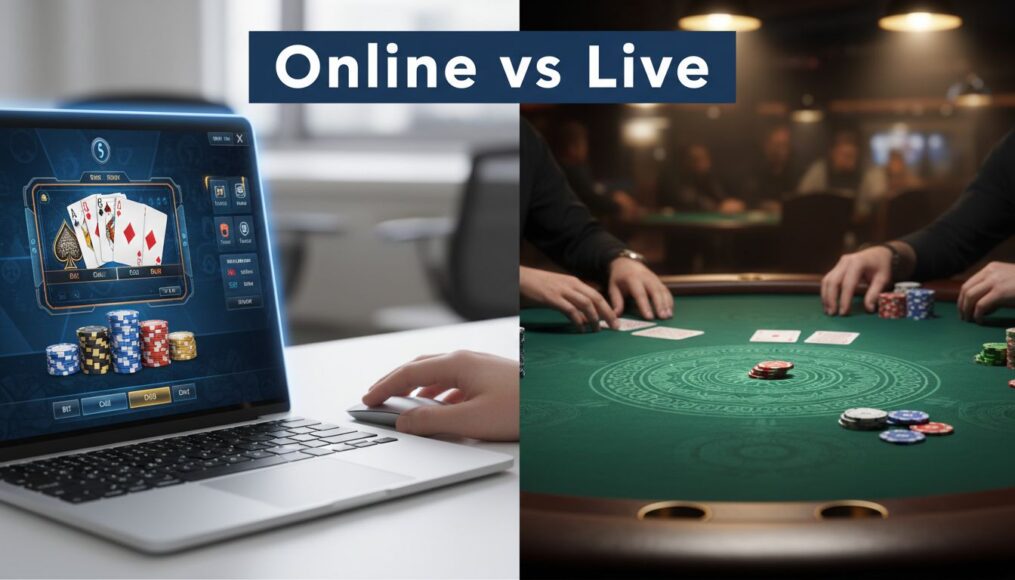
For poker enthusiasts across India, the game offers two distinct yet equally thrilling experiences: the virtual tables of online poker and the tangible felt of live poker rooms. While the core rules and hand rankings remain consistent, the environment, pace, and strategic nuances differ significantly, shaping a player's journey in unique ways. Understanding these distinctions is key to mastering either format or seamlessly transitioning between them.
Whether you're a seasoned pro or just starting your poker adventure in 2025, exploring the unique characteristics of online versus live play can help you decide where your skills might best flourish. Let's delve into the fascinating world of poker and uncover what sets these two popular formats apart.
Online Poker vs. Live Poker: A Detailed Comparison
At its heart, poker is a game of skill, strategy, and psychology. Both online and live formats demand these attributes, but the way they manifest can be surprisingly different. From the speed of play to the way bets are made, each environment presents its own set of challenges and advantages.

1. Game Pace and Volume
One of the most immediate differences players notice is the speed of the game. Online poker tables are designed for efficiency, allowing for rapid hand dealing, automated shuffling, and instant pot calculations. This means players can typically experience around 60 hands per hour, and often more if multi-tabling. In contrast, live no-limit Hold'em cash games usually average about 30 hands per hour, due to physical dealing, chip counting, and player decision-making time.
This higher volume in online poker means more opportunities to play hands, but also intensifies the impact of variance over shorter periods.
2. Bet Sizing and Pot Dynamics
Betting patterns often diverge significantly between online and live games. Online, it's common to see preflop open raises of 2x, 2.5x, or 3x the big blind. Live games, especially at lower stakes in India, frequently feature larger opening bets, sometimes 5 times the big blind or even more. This difference in bet sizing often leads to more multi-way pots in live poker, as larger bets can deter some callers, but also encourage others to see a flop with a wider range of hands.
Online games, with their smaller preflop raises, tend to result in more heads-up scenarios post-flop, demanding different strategic adjustments.
3. Player Pool and Skill Levels
The accessibility of online poker means a vast and diverse player pool. At comparable stakes, online tables often attract a higher concentration of skilled players who utilize tracking software and advanced strategies. Live games, while still competitive, can sometimes feature a broader range of player types, including more recreational players who might be less familiar with optimal strategies.
Many experienced players in India often use the “10-to-1” rule of thumb, suggesting that a ₹100/₹200 live game might be comparable in skill to a ₹10/₹20 online game.
4. Tells and Information Gathering
In live poker, physical tells are a crucial aspect of the game. Observing an opponent's body language, eye movements, breathing patterns, and chip handling can provide invaluable information about the strength of their hand. This psychological element is entirely absent online. Online players must rely solely on betting patterns, timing tells, and statistical data (often gathered through third-party software) to deduce their opponents' holdings and intentions.
5. Variance and “Bad Beats”
While the mathematical probability of a “bad beat” (losing with a strong hand to a weaker one that improves) is the same in both formats, online players often perceive them as happening more frequently. This perception stems from the higher volume of hands played and the tendency for more players to call bets with marginal hands, especially at micro-stakes. More callers mean more opportunities for long-shot draws to hit, leading to more frequent “bad beat” scenarios in a shorter timeframe. Online poker generally exhibits higher variance, meaning bigger swings in wins and losses over a short period.
6. Convenience and Accessibility
Online poker offers unparalleled convenience. Players can join games 24/7 from the comfort of their homes, or on the go via mobile apps, without the need for travel or specific attire. Live poker, on the other hand, provides a social experience, the thrill of a physical casino environment, and direct interaction with dealers and other players. For many, the camaraderie and atmosphere of a live poker room are irreplaceable.
7. Technology and Tools
Technology plays a much larger role in online poker. Players can use Heads-Up Displays (HUDs) to track opponent statistics in real-time, review hand histories instantly, and utilize various poker software for analysis and improvement. Live poker is a more raw experience, relying purely on a player's memory, observation skills, and mental calculations.
Choosing Your Arena: Online Poker Platforms in India
For Indian players looking to dive into online poker, selecting the right platform is crucial. While we don't list specific sites, we recommend looking for platforms that offer:
- Proper Licensing and Regulation: Ensure the platform operates legally and adheres to fair play standards.
- Game Variety: A good selection of cash games, tournaments, and different poker variants (Texas Hold'em, Omaha, etc.).
- Secure Payment Methods: Support for popular Indian payment options like UPI, NetBanking, Paytm, and Google Pay for easy deposits and withdrawals.
- Robust Software: A stable, user-friendly interface that works well on both desktop and mobile devices.
- Customer Support: Responsive and helpful customer service.
- Bonuses and Promotions: Attractive welcome bonuses and ongoing promotions for loyal players.
Always remember to play responsibly and within your means, adhering to the legal gambling age (18 or 21, depending on state laws in India).
Frequently Asked Questions (FAQs)
Is online poker more profitable than live poker?
Profitability in poker is highly individual, depending on skill, game selection, and bankroll management. Online poker offers higher volume and potentially more opportunities to find softer games, which can lead to increased profits for skilled players. However, live poker can offer a more exploitable player pool due to fewer advanced players and the presence of physical tells, which can also be highly profitable for those who excel at reading opponents.
Which format is more suitable for beginners?
Both formats have merits for beginners. Online poker allows players to start at very low stakes, learn at their own pace, and access numerous tutorials and training tools. It's a great way to build foundational skills without high financial risk. Live poker offers a more social and less intimidating environment for some, allowing them to learn by observing and interacting with others, though the stakes might be higher.
How does the use of technology impact online poker?
Technology significantly enhances the online poker experience by providing features like tracking software, instant hand histories, and automated calculations. This can help players analyze their game and improve faster. However, it also means that opponents might be using similar tools, leading to a more competitive environment. The rapid pace enabled by technology can also lead to faster decision-making, which might affect the strategic depth for some players.
Summary
Poker, in its various forms, continues to captivate players across India and globally. We've explored the fundamental differences between online and live poker, highlighting how each offers a unique experience for enthusiasts.
Online poker stands out for its convenience, rapid gameplay, and technological integration. It provides a high-volume environment with higher variance, appealing to those who thrive on action and data-driven strategy. Players must adapt to faster decision-making and the absence of physical tells, relying instead on betting patterns and software insights.
Live poker, conversely, offers an authentic, social, and tactile experience. The slower pace allows for deeper observation of opponents' physical tells and fosters a sense of camaraderie. While it may involve more multi-way pots and different bet sizing dynamics, the human element is paramount.
Ultimately, the choice between online and live poker boils down to personal preference, skill set, and what you seek from your poker journey. Many players in India enjoy both, leveraging the strengths of each format to hone their overall game. Whether you prefer the digital realm's strategic depth or the tangible allure of the casino floor, the world of poker welcomes you to test your mettle. Remember to always play responsibly and within legal limits.

Lukas
Head of contentLukas is one of the leading authors at Casinoble. He entered the casino world through his passion for online poker. Lukas is also a dedicated sports betting fan. At Casinoble, Lukas usually writes about Live Dealer Games, Sportsbetting and Betting Strategies.
Most Read News
Get the latest information





Join Our Telegram!
Exclusive bonuses