Casino
 Betting
 Games
Games 
 Banking
 Bonuses

India vs Thailand: How Two Asian Markets Are Handling Online Casino Regulation

- India vs Thailand: How Two Asian Markets Are Handling Online Casino Regulation

 Author: Lukas Mollberg
 Updated: 8 June, 2026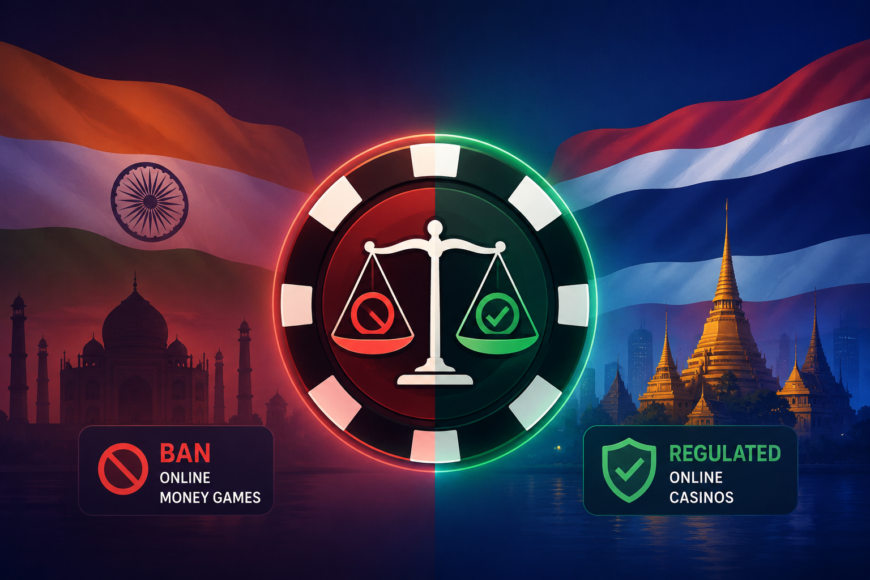
Asia holds some of the world's most contradictory gambling landscapes. India and Thailand illustrate this better than most. Both countries sit in the same region, but each has chosen a radically different path for governing online casino activity. Both carry enormous player populations, deep underground gambling cultures, and governments that had to confront the reality of digital gaming head-on. How each country responded reveals something important — not just about gambling law, but about how governments weigh economic opportunity against cultural identity and consumer protection.
India spent years operating under a fragmented patchwork of state-level gambling rules dating back to colonial legislation. Thailand, meanwhile, maintained one of the most comprehensive blanket bans in Southeast Asia for nearly a century. By 2025 and into 2026, both countries hit regulatory turning points — but they moved in opposite directions. We at Casinoble track these developments closely because they directly affect which platforms stay accessible, which payment methods remain viable, and what protections players can realistically count on.
This comparison examines what each country has done, why they did it, and what the divergence reveals about governing online gambling in Asia's emerging markets. For players looking at licensed real money casino options, the regulatory direction each country takes has direct consequences on what is accessible and what is not.
How India Arrived at a National Ban
For most of its modern history, India governed gambling through the Public Gambling Act of 1867 — a colonial-era statute built around physical gambling houses. It said almost nothing about digital play. States drew their own lines. Goa licensed land-based casinos. Sikkim built a limited online gaming framework. Others banned nearly everything. The result was a legal maze where the same game could be perfectly legal in one state and a criminal offence two hundred kilometres away.
This ambiguity became harder to sustain as online real-money gaming exploded. By the early 2020s, India had developed one of the fastest-growing fantasy sports and online card game ecosystems in the world. Tens of millions of users were active. Billions of dollars moved through platforms annually. Operators argued that rummy and fantasy cricket were skill-based games, exempt from gambling prohibitions. Courts in different states disagreed with each other. The central government largely stayed out.
That changed in 2023. The Ministry of Electronics and Information Technology amended its intermediary guidelines to introduce a registration framework for online gaming platforms. The move acknowledged that the space needed federal oversight. But those 2023 rules were only a starting point. They did not resolve whether real-money games were legal. Two more years of legislative work, industry lobbying, and growing public concern about addiction and financial harm — particularly among younger users — followed.
The Promotion and Regulation of Online Gaming Act, 2025
India's Parliament passed the Promotion and Regulation of Online Gaming Act in August 2025. The legislation received presidential assent on August 22, 2025. It came into force alongside the accompanying Rules framework on May 1, 2026. The Act imposed a nationwide ban on all online money games. The scope was sweeping.
PROGA defines an “online money game” broadly. It covers any digital game where a player deposits money or stakes in exchange for the chance of a monetary return. This captures casino-style games like roulette and slots, but also fantasy sports, real-money card games, and most forms of online betting. Platforms had until May 1, 2026 to comply — either by shutting down real-money operations or restructuring entirely. Within the first ninety days after the Act's passage, platforms recorded asset write-downs exceeding $840 million.
Rationale, Penalties, and Early Pushback
The government framed the Act as a public welfare measure. Technology Minister Ashwini Vaishnaw argued it targeted a serious social harm. Data suggested roughly a third of India's population had lost an estimated $2.3 billion per year on wagers. Critics pushed back immediately. Their core concern was one that applies to every prohibition attempt: it pushes demand underground rather than eliminating it. Constitutional challenges arrived fast — filed in the Karnataka, Delhi, and Madhya Pradesh High Courts within weeks. The Supreme Court consolidated these cases in September 2025 and scheduled a review for early 2026.
PROGA's penalties are steep. Offering or advertising an online money game carries up to five years in prison and substantial fines. The Act also claims extraterritorial jurisdiction over platforms that operate from outside India but target Indian users. Enforcing that provision against foreign operators is a practical challenge. But the legislative intent is clear.
The Act effectively removed a wide range of products from the legal market — the full scope is covered in the live casino table games guide on Casinoble.
Thailand's Path: From Prohibition Toward Regulated Complexes
Thailand's gambling history mirrors India's in one key respect: an old, blunt law doing increasingly inadequate work in a digital world. The Gambling Act of 1935 set Thailand's default as total prohibition. Only two exceptions existed — state-controlled lotteries and licensed horse racing. For nine decades, that was the framework. Underground gambling flourished around it. An enormous shadow economy grew. No consumer protections existed. No tax revenue flowed to the government.
By the 2020s, the gap between law and reality had become politically unsustainable. Offshore online gambling sites reached millions of Thai users with minimal friction. Illegal gambling dens operated openly in tourist areas. Organised crime controlled significant portions of the unregulated market. Periodic crackdowns made headlines — raids across Bangkok and Pattaya, seizures of billions in assets — but enforcement alone did not reduce demand. The policy debate shifted. It was no longer a question of whether Thailand would legalise gambling, but when and how.
The Entertainment Complex Bill and the 2026 Reform
The answer came through a multi-year legislative process that picked up speed in 2025. On January 13, 2025, the Thai Cabinet approved in principle the Draft Entertainment Complex Business Act. The framework proposed legalising casinos within large integrated resort complexes — venues that would also include hotels, convention centres, retail spaces, and entertainment facilities. The model drew clear comparisons to Singapore's approach with Marina Bay Sands and Resorts World Sentosa.
The bill's passage was not smooth. Political instability created delays. A border conflict with Cambodia and the subsequent impeachment of Prime Minister Paetongtarn Shinawatra disrupted parliamentary proceedings in mid-2025. Her successor, Anutin Charnvirakul, initially said casino legislation would not move forward under his tenure. Despite those setbacks, the Entertainment Complex Business Act was enacted in the first quarter of 2026.
The licensing structure demands serious financial commitment from operators. Key terms include:
- An initial licence fee of five billion baht (approximately $150 million USD)
- An annual renewal fee of one billion baht (approximately $30 million USD)
- A feasibility study-suggested tax rate of 20% on gross gaming revenue (not yet officially confirmed)
- Mandatory inspections every five years by the Entertainment Complexes Operation Regulatory Office
What the Act Does and Does Not Cover
The regulatory architecture focuses entirely on physical integrated resorts. Online gambling sits outside this framework entirely. Thailand moved from total prohibition of physical casinos to a licensed, heavily regulated physical model — but it created no pathway for online casino operations. Discussions about whether a future online framework would be needed to address persistent offshore play were ongoing but unresolved as of mid-2026. The digital segment remains in the same legal position it held under the 1935 Act.
Comparing the Two Approaches
The contrast between both countries' regulatory responses is sharp. India chose federal prohibition. Thailand chose selective physical legalisation. Both decisions grew from similar pressures — public health concerns, tax leakage, and laws that could not manage actual consumer behaviour. But the outcomes pull in opposite directions. The table below maps where each country stands across the key regulatory dimensions.
| Feature | India (as of May 2026) | Thailand (as of Q1 2026) |
|---|---|---|
| Online casino legal status | Banned nationwide under PROGA 2025 | Still illegal; no online licensing framework |
| Physical casino status | State-licensed; limited to Goa, Sikkim, Daman | Newly legalised within integrated resort complexes |
| Governing legislation | Promotion and Regulation of Online Gaming Act, 2025 | Entertainment Complex Business Act, 2026 |
| Regulatory authority | Online Gaming Authority of India (NOGC) | Entertainment Complexes Operation Regulatory Office |
| Penalties for illegal operation | Up to 5 years imprisonment and fines | Existing Gambling Act of 1935 penalties apply |
| Tax framework | GST proposed at 28–40% on gaming revenues | Estimated 20% on gross gaming revenue (unconfirmed) |
| Constitutional challenges | Active; Supreme Court review underway | None significant at time of writing |
| Offshore player access | Legally prohibited; enforcement limited | Technically illegal; widely practised |
The table makes one thing clear: both countries are still working through the implications of their chosen frameworks. India's approach is stricter on paper. But it faces real enforcement challenges against the offshore market. Thailand's approach creates a legal pathway for physical gaming. But it leaves digital play in the same grey zone it has occupied for decades.
The Underground Market Problem Both Countries Share
Neither prohibition nor partial legalisation has resolved the core challenge both countries face: an underground gambling market deeply embedded in everyday life. In India, offshore platforms operating from Malta, Gibraltar, and Curaçao still accept Indian users. They process payments through cryptocurrency or third-party intermediaries. PROGA's extraterritorial provisions are largely aspirational. Blocking offshore operators from targeting Indian users is technically and practically difficult. VPN usage is widespread. The law exists on paper, but enforcement at the player level is minimal.
Thailand faces the same structural problem. Thai players access offshore platforms with little friction. Their options for licensed real money casino play remain extremely limited. For a broader view of what the market currently looks like for players in the region, Best Online Casinos for Thai Players offers a helpful resource on available platforms and what to look for. Demand flowing to unregulated platforms carries no consumer protections — no responsible gambling tools, no verified random number generators, no dispute resolution mechanisms. That gap is exactly what effective regulation should close. Neither country has closed it yet.
Why Prohibition Rarely Works as Intended
The psychology behind gambling behaviour matters here. In both countries, gambling is culturally embedded despite legal restrictions. Research consistently shows that prohibition drives behaviour underground rather than eliminating it. Players do not stop when a government bans something. They move to less visible, less safe alternatives. The question regulators wrestle with is whether harm is better managed through open, taxed, regulated frameworks — or through blanket restriction and enforcement. Markets that have regulated successfully — the UK, Malta, and Australia among them — demonstrate that harm minimisation and consumer protection are more achievable under licensing than under prohibition.
Licensed platforms structure responsible gaming environments in specific, audited ways. The live baccarat on regulated platforms page illustrates the kind of transparent experience legitimate operators provide — a clear contrast to unregulated offshore alternatives.
What Comes Next in Both Markets
India's regulatory future hinges on the Supreme Court's review of PROGA's constitutionality. Legal scholars have argued that the Act's blanket prohibition overreaches. Decades of judicial precedent distinguished skill-based games from pure chance. If the Supreme Court demands amendments, a tiered licensing model — the kind that multiple European jurisdictions use successfully — could become the more durable outcome. The GST issue adds further complexity. Proposals to raise gambling-related tax rates to 40% would reshape any future legal framework significantly.
Key questions India will need to resolve include:
- Whether the Supreme Court upholds, amends, or strikes down PROGA's core prohibitions
- How the government plans to address persistent offshore access by Indian users
- What tax structure would apply if a licensed framework replaces the current ban
- How state-level gambling authority interacts with the new federal legislation
Thailand's trajectory points toward gradual, physically anchored legalisation. The bidding process for integrated resort licences was expected to begin in the latter half of 2026. Full operations remain years away. Whether online regulation follows depends on how effectively the physical model reduces illegal market activity. If offshore and underground play stays pervasive, the argument for a parallel online licensing framework will grow louder. Thailand's Tourism Authority estimated that legal integrated resorts could attract over 100 billion baht in new investment. That financial incentive gives the government a strong reason to make the physical model work before moving into digital regulation.
Sports wagering is one of the most contested categories in both countries' legal frameworks, and regulatory changes affect it first. The sports betting in regulated Asian markets section tracks how those shifts play out in practice.
Conclusion
India and Thailand took fundamentally different roads. One chose sweeping national prohibition. The other chose selective physical legalisation that leaves the digital segment unresolved. Both approaches reflect genuine policy dilemmas. Neither has produced a framework that fully addresses the offshore market, player protection, and tax capture at the same time. What both countries share is a recognition that the old laws — written in a pre-digital era — can no longer govern what is actually happening.
Regulation is not a single decision. It is an ongoing process. Legal frameworks get tested in courts, revised by legislators, and challenged by the reality of how people actually behave. At Casinoble, we monitor these developments continuously so that the information we publish reflects the regulatory environment players are navigating today — not just the intentions lawmakers had when they drafted the rules.

Lukas Mollberg
Casino Expert | Head of Content at CasinobleLukas Mollberg is an experienced iGaming analyst and editorial lead with more than twenty years in gaming and digital media, including over eight years focused on online casinos. As Head of Content at Casinoble, he guides the editorial team, shapes review methodology, and ensures that research and analysis are grounded in verified data and clear evaluation standards.
Most Read News
Get the latest information